Heat and the mind: what we know about climate change and mental health
When we talk about the health effects of heatwaves and cold surges, we usually mean the body: heat stroke, heart attacks, hospital admissions among older people. These effects are well documented. Many young and healthy people therefore conclude that extreme weather is not their problem. They stay indoors, turn on the air conditioner, and wait for it to pass.
But heat also acts on the mind, and the mind shapes everything we do. Picture a pitcher on a scorching afternoon. The arm may be fine while judgment and temper are not. This side of climate change is harder to measure than mortality or crop yields, and it is less well understood. An umbrella review by Joaquim Radua and colleagues in World Psychiatry is one of the best attempts so far to sort out what we actually know (Radua et al. 2024). This post summarizes it.
A pitcher on a hot day
The baseball example is not hypothetical. Larrick and colleagues analyzed 57,293 Major League Baseball games and asked when pitchers hit batters (Larrick et al. 2011). After controlling for other factors, the probability of a hit batter rose sharply at high temperatures when more of the pitcher’s own teammates had been hit earlier in the game. The authors suggest that heat makes people more likely to read hostility into others’ actions and lowers their inhibitions against retaliating.
Note what this study shows and what it does not. It shows that heat changes behavior that depends on judgment and self-control, in skilled, healthy, highly motivated professionals. It does not show that fastballs get slower on hot days because of mental state; I know of no study that separates the mental and physical sides of pitching performance in the heat. That gap is typical of the whole field.
Why mental health is hard to put numbers on
Mental health outcomes range from a bad mood to suicide, and most of them never appear in any database. Researchers therefore rely on what is recorded: suicides, hospital admissions, emergency visits, diagnoses, or survey scales. Individual studies often disagree. One finds that fine particulate matter is linked to depression, another with a larger sample finds no link; one finds that hot days raise suicide mortality, another does not replicate it. Even meta-analyses contradict each other.
An umbrella review goes one level up. Radua and colleagues collected every systematic review with meta-analysis on air pollution or climate change hazards and mental health published up to June 2023: 32 meta-analyses covering 284 individual studies and 237 exposure–outcome associations. Most associations (195) concerned air pollution; 42 concerned climate hazards, and 35 of those were about temperature.
They then graded each association with standard credibility criteria. To be “convincing” (class I), an association needs more than 1,000 cases, a p-value below 10⁻⁶, no sign of small-study effects or excess significance bias, a prediction interval that excludes the null, low heterogeneity, and a significant result in the largest study. “Highly suggestive” (class II) relaxes some of these requirements. Most associations failed even the weaker tests (Figure 1).
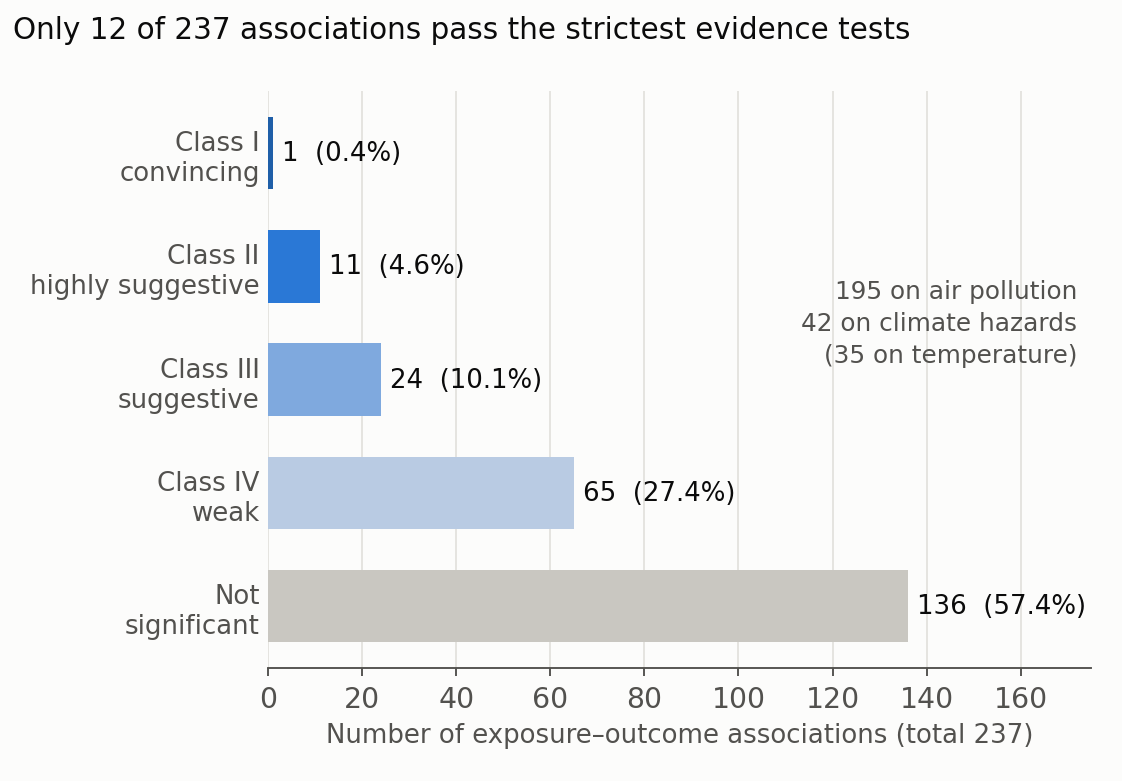
Figure 1. Credibility of the 237 associations between air pollution or climate change hazards and mental health outcomes. Only one reached class I (convincing) and eleven class II (highly suggestive); more than half were not statistically significant. Figure by Daeha Kim, drawn from numbers reported in Radua et al. (2024).
What holds up: heat and suicide
The strongest climate findings concern short-term heat, meaning temperature over days to weeks (Figure 2a). For every 1°C increase in temperature:
- deaths from suicide or mental disorders rise by 2.4%;
- suicidal behavior (deaths, attempts, ideation or self-harm) rises by 1.2%;
- hospital admissions or emergency visits for suicidal behavior or mental disorders rise by 1.1%, and for mental disorders alone by 0.9%.
Apparent temperature, which combines air temperature with humidity to express how hot it feels, shows a similar link with suicidal behavior (1.0% per 1°C). All five reach class II, and all five survive a sensitivity analysis restricted to longitudinal studies, in which the exposure clearly comes before the outcome.
One climate hazard besides temperature also reached class II: people more recently exposed to a cyclone had more severe post-traumatic stress symptoms. That finding rested only on cross-sectional studies, however, and did not survive the longitudinal analysis.
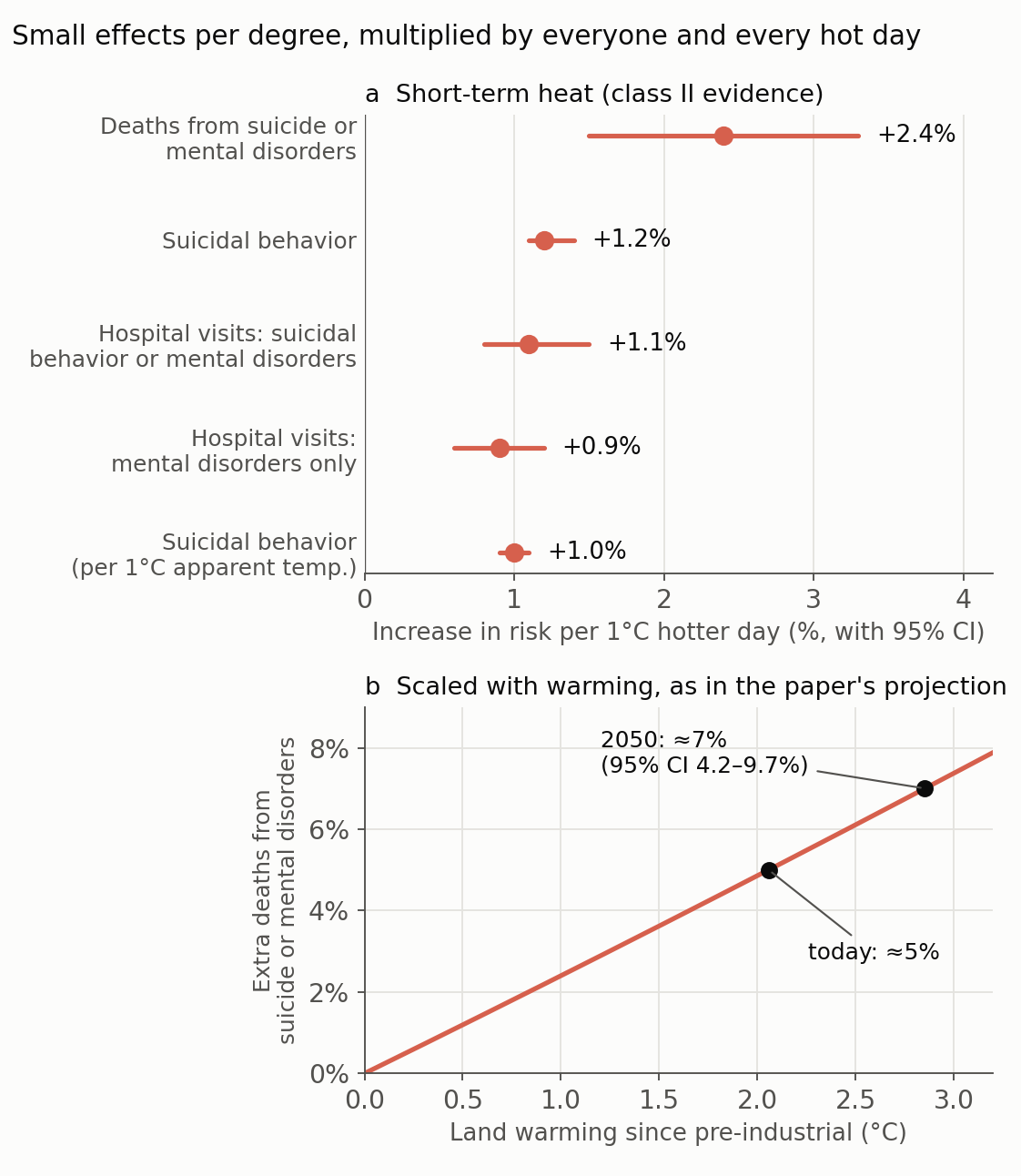
Figure 2. (a) Increase in the risk of five mental health outcomes per 1°C rise in short-term temperature, with 95% confidence intervals; all are class II associations. (b) The mortality estimate scaled with land warming since the pre-industrial period, as in the paper’s complementary analysis. The paper estimates about 5% today and about 7% by 2050; the markers sit where the curve reaches those values. Figure by Daeha Kim, drawn from numbers reported in Radua et al. (2024).
Small effects, large numbers
A 1–2% increase per degree sounds small. The authors’ point is that it applies to the whole population on every hot day. To show what this could mean, they combined the mortality estimate with the rise in global land temperature since 1750–1799. By their calculation, deaths from suicide or mental disorders are already about 5% higher than in a pre-industrial climate, and will be about 7% higher by 2050 (95% CI 4.2–9.7%) if land temperatures keep rising at the recent rate (Figure 2b).
This projection should be read as an illustration, not a forecast. It applies a risk estimated for day-to-day temperature swings to a slow rise in the annual mean, and it assumes the relationship is linear and that people do not adapt. Each of those assumptions could be wrong in either direction.
Not only the vulnerable
The review does not analyze age, but other studies speak directly to young and healthy people.
In the summer of 2016, researchers followed 44 university students in the Boston area, with a mean age of 20, through a heatwave (Cedeño Laurent et al. 2018). Twenty lived in buildings without air conditioning, where indoor temperatures averaged 26.3°C; the others lived in air-conditioned buildings at 21.4°C. During the heatwave, the students without air conditioning took 13.4% longer to respond on a color-word attention test and 13.3% longer on simple arithmetic, relative to the air-conditioned group. On the attention test, performance was best at indoor temperatures of 22–23°C. Staying indoors only protects you if the indoor air is cool, and buildings designed to keep heat in during winter can stay hot long after a heatwave passes.
Climate change also affects young people’s minds through worry rather than heat. In a survey of 10,000 people aged 16–25 in ten countries, 59% said they were very or extremely worried about climate change, and more than 45% said their feelings about it negatively affected their daily life and functioning (Hickman et al. 2021). The review mentions this kind of distress (eco-anxiety, ecological grief, solastalgia) but could not grade it, because no meta-analyses of it existed yet.
What the review cannot tell us
The authors are frank about the limits, and they are worth repeating:
- The underlying evidence is weak. Every one of the 32 meta-analyses was rated low or critically low in methodological quality, mostly for poor handling of heterogeneity and incomplete reporting.
- Association is not causation. Exposures such as heat and air pollution occur together, and age, sex and income may confound or modify the links. The review could not separate them.
- Cold is an open question. No association with cold reached high credibility, but the authors note that this does not rule out harm from extreme cold, which has been reported in Northern Europe. For cold surges, the evidence is thinner than for heat.
- Thresholds are unknown. Effects were analyzed per degree. Whether risk rises sharply above some temperature, as it does for physical health, was not tested.
Air pollution, the other half of the review, produced the only convincing association: long-term exposure to solvents is linked to 14% higher odds of dementia or cognitive impairment. Class II links included carbon monoxide and nitrogen oxides with dementia, particulate matter during pregnancy with postpartum depression, and sulfur dioxide with schizophrenia relapse.
What a hydrometeorologist takes from it
Humidity matters for the mind, too. Apparent temperature, which depends on humidity, carried a link with suicidal behavior as strong as air temperature. Heat warnings based on air temperature alone may miss humid days that feel worse than they read.
Indoor climate is part of exposure. Weather stations measure outdoor air, but people experience the indoor temperature of their homes, classrooms and offices. Linking urban climate and building data to health records would sharpen these estimates a great deal.
Heat warnings could include mental health. Heat-health warning systems already target older people and outdoor workers. The evidence here suggests that mental health services and suicide prevention belong in those plans as well.
Bottom line
The umbrella review confirms that climate change affects mental health, not only physical health. The most credible link is between hot days and suicide, deaths from mental disorders, and psychiatric hospital visits: roughly 1–2.4% more per 1°C. The effects are small for any one person but apply to everyone, every hot day, and they reach young and healthy people too, through slower thinking, shorter tempers and worry about the future. The evidence base is still weak, and questions such as cold, thresholds and causation remain open. Mental health deserves a place in how we measure the human cost of a warming climate.
Questions to think about
- In the pitcher study, the heat effect was tied to provocation. What does that suggest about how heat interacts with stress at work or at home?
- How would you design a study to separate the mental and physical effects of heat on athletic performance?
- Korean summers are hot and humid, and winters bring cold surges. Which data would you need to test whether cold affects mental health outcomes in Korea?
한 줄 요약 (Korean summary). 폭염과 한파가 신체 건강에 미치는 영향은 잘 알려져 있지만, 정신 건강에 미치는 영향은 수치로 다루기 어렵고 아직 잘 이해되지 않았다. Radua 등(2024, 『World Psychiatry』)은 2023년 6월까지 발표된 메타분석 32편(개별 연구 284편, 연관성 237개)을 모아 증거의 신뢰도를 평가했다. 가장 엄격한 기준을 통과한 연관성은 12개(5%)뿐이었고, 기후 관련 결과 중에는 단기 기온 상승의 영향이 가장 확실했다. 기온이 1°C 오를 때마다 자살 및 정신질환 관련 사망은 2.4%, 자살 행동은 1.2%, 자살 행동이나 정신질환으로 인한 병원 방문은 1.1% 늘었고, 습도를 반영한 체감온도도 비슷한 결과를 보였다. 한 사람에게는 작은 효과지만 모든 사람에게 더운 날마다 적용되므로, 저자들은 산업화 이전에 비해 이미 관련 사망이 약 5% 늘었고 2050년에는 약 7%에 이를 것으로 추정했다. 젊고 건강한 사람도 예외가 아니다. 미국 프로야구 5만7천여 경기를 분석한 연구에서는 더운 날 동료 타자가 맞은 뒤의 보복성 몸에 맞는 공이 크게 늘었고, 폭염 동안 에어컨 없는 기숙사에 산 대학생은 인지 반응 속도가 약 13% 느려졌으며, 16–25세 1만 명 조사에서는 45% 이상이 기후변화에 대한 걱정이 일상에 영향을 준다고 답했다. 다만 포함된 메타분석의 질은 모두 낮았고, 연관성이 곧 인과관계는 아니며, 한파의 영향과 임계 온도는 아직 밝혀지지 않았다.
References
Radua, J., De Prisco, M., Oliva, V., Fico, G., Vieta, E., & Fusar-Poli, P. (2024). Impact of air pollution and climate change on mental health outcomes: an umbrella review of global evidence. World Psychiatry, 23, 244–256. https://doi.org/10.1002/wps.21219
Cedeño Laurent, J. G., Williams, A., Oulhote, Y., Zanobetti, A., Allen, J. G., & Spengler, J. D. (2018). Reduced cognitive function during a heat wave among residents of non-air-conditioned buildings: an observational study of young adults in the summer of 2016. PLoS Medicine, 15, e1002605. https://doi.org/10.1371/journal.pmed.1002605
Hickman, C., Marks, E., Pihkala, P., Clayton, S., Lewandowski, R. E., Mayall, E. E., Wray, B., Mellor, C., & van Susteren, L. (2021). Climate anxiety in children and young people and their beliefs about government responses to climate change: a global survey. The Lancet Planetary Health, 5, e863–e873. https://doi.org/10.1016/S2542-5196(21)00278-3
Larrick, R. P., Timmerman, T. A., Carton, A. M., & Abrevaya, J. (2011). Temper, temperature, and temptation: heat-related retaliation in baseball. Psychological Science, 22, 423–428. https://doi.org/10.1177/0956797611399292
Both figures are original. The Python scripts that produce them are available on GitHub: Figure 1, Figure 2.