Smarter AI or better-organized AI? Why coordination may decide when the economy changes
Every few months a new AI model passes a test that seemed years away: writing production software, beating domain experts on exams, solving hard problems in mathematics. Yet the economy around us looks much the same. Most people go to recognizable jobs, headcounts are similar to a few years ago, and national productivity figures have barely moved. Why the gap?
In an essay published by the DeepMind Institute, Alex Imas, Andrew Koh and Shane Legg of Google DeepMind offer an answer (Imas et al., 2026a). The full economic model is in a companion paper, Organizing Intelligence (Imas et al., 2026b); this post follows the essay. Their main point is that a single AI agent is the wrong thing to measure. The economy is made of organizations, and what matters is whether an organization of AI agents can do better than an organization of people.
1. Jagged people, mosaic organizations
The authors gave a quiz to 100 people across six areas: math, verbal reasoning, science, patterns, culture and economics. How well someone did in one area said little about how they did in another. People were not copies of an “average intelligence.” They were jagged: strong in some areas, weak in others, and jagged in different directions.
Organizations exist partly to make use of this. They put together people whose strengths complement each other, so the team covers ground that no member covers alone. Economists call this comparative advantage: each person does what they are relatively best at. The authors call the result mosaic intelligence. In their quiz data, pairs of people matched to complement each other outperformed random pairs by 32%.
Organizations also create value for a third kind of worker: the coordinator, or manager. On any single-person test, a pure coordinator looks weak, average at everything. Inside a team, though, a good coordinator makes hand-offs smoother, lets the team grow without losing focus and makes every specialist more productive. That is why managers are among the best paid, even though they may not excel at any one task.
AI models are jagged too: they can solve advanced math and then stumble on something simple. But different models tend to be jagged in similar ways. Adding a different human specialist fills a gap; adding another copy of the same model adds capacity but not breadth. So a model that beats every individual person, one on one, can still lose in the market to a well-organized team of people, none of whom could beat it alone. The useful question is not “is the model better than a human?” but “can an organization of AI agents beat an organization of humans, or of humans and agents together?”
2. Two ways AI is different from human workers
AI can be copied. Human expertise is limited: each person has only so many hours, and hiring more skilled people pushes their wages up. Once a model reaches some level of capability, it can be run in any quantity at the price of computing power. The consequence the authors draw is simple and stark: when a model can match a person at a task, the wage for that task becomes tied to the cost of compute.
AI might coordinate much better than people. The economist Ronald Coase asked why, if organizing work inside a firm saves money, all production is not done by one giant firm. The usual answer is human limits. Two colleagues can keep a whole project in their heads; with 20 or 200, attention stretches thin, details get lost when work is handed over, much knowledge is hard to put into words, and personal career interests pull people in different directions. History shows what happens when these limits loosen: the telegraph and the railroad did not make individual workers more skilled, but by making communication faster and more reliable, they helped create the large modern firm.
None of these limits has to apply to AI agents. Copies of a model share the same weights and can, in principle, pass along their entire working state (whole codebases, partial derivations, full context) without career worries. Today they coordinate poorly in practice, but the potential is large.
3. Competence sets the level; coordination sets the scale
This leads to the essay’s central idea. Any organization’s capability can be split into two parts:
- Competence: how much each member can do. It sets the level of output per worker.
- Coordination: how well members work together. It sets how big an organization can grow before it becomes too messy to function.
The authors trace output per worker as an organization grows and call the result organizational scaling laws, by analogy with the scaling laws for AI models. There are three phases. If coordination is very poor, working alone is best. Above a basic level, dividing the work raises output per person at first, then levels off and declines as the organization gets too large; this is the world we have always lived in. If coordination passes a higher supercooperative threshold, each new member makes the organization more productive than the last, and size is limited only by the size of the market (Figure 1).
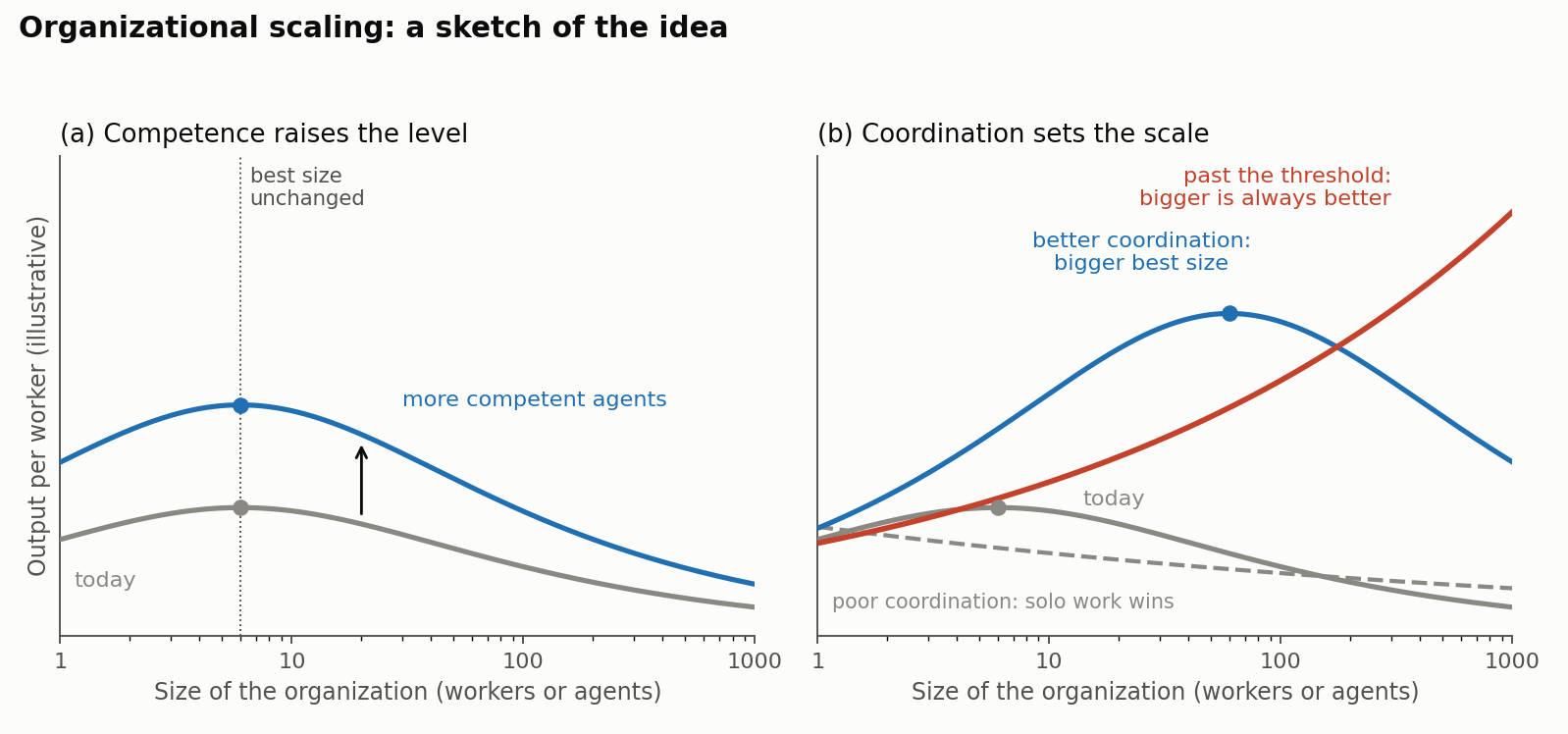
Figure 1. A sketch of the idea of organizational scaling. (a) More competent members raise output per worker, but the best size of the organization (dots) stays the same. (b) Better coordination moves the best size to larger organizations; past the supercooperative threshold (red), bigger is always better. The curves use a simple made-up formula to show the shapes described in the essay; they are not results from the authors’ model. Figure by Daeha Kim.
The key consequence: competence changes the economy gradually, coordination changes it abruptly. Better competence shifts prices, wages and the mix of people and AI smoothly, while firms stay about the same size. Crossing the coordination threshold could cause sudden jumps in how concentrated industries are, in employment and in wages.
4. Four regimes of AI capability
Treating competence and coordination as two separate dials gives four regimes (Figure 2). To see how each plays out, the authors look at three kinds of sectors: deep, scalable markets with huge standardized demand (software, logistics, finance); niche markets with smaller, specialized demand; and the relational sector, where human involvement is itself part of the value (healthcare, teaching, many services and crafts).
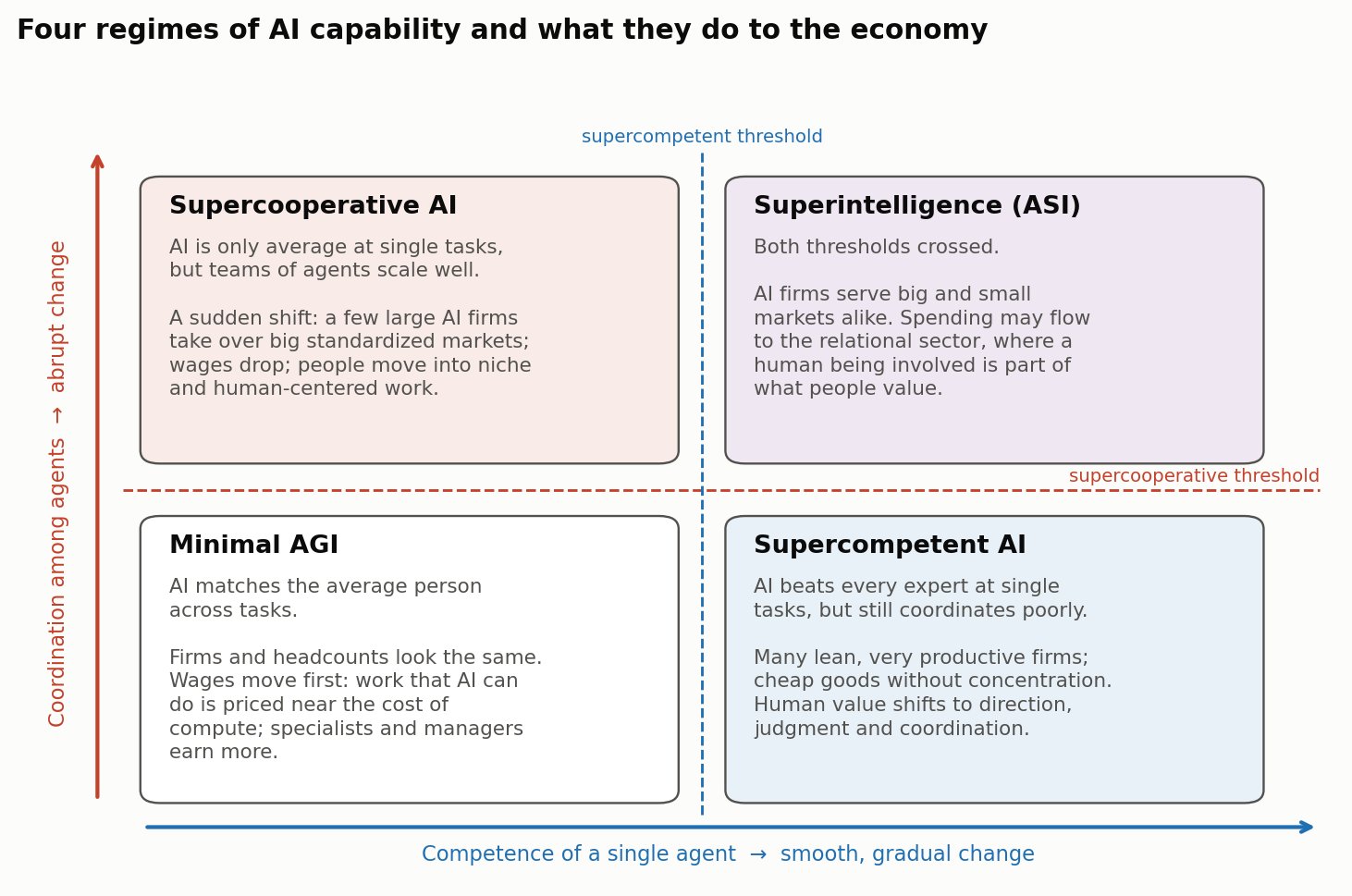
Figure 2. The four regimes described by Imas et al. (2026a), summarized in my own words. Moving right (competence) changes the economy smoothly; moving up past the supercooperative threshold (coordination) changes it abruptly. Figure by Daeha Kim.
- Minimal AGI. AI matches or exceeds the average person across tasks. Surprisingly little changes in how the economy is organized: teams of complementary experts still beat firms of “average” AI, and industries stay spread across many small and medium firms. The change shows up in wages. Workers whose skills AI can match see their pay pushed toward the cost of compute, while specialists and coordinators can earn more. Small AI firms enter price-sensitive niche markets and push prices down. The authors draw a lesson for today’s debate: because wages change before organizations do, steady employment numbers are weak evidence that AI is having no effect.
- Supercompetent AI. AI beats every human expert at every task except coordination. Still, little structural change: firms become far more productive but not larger, and probably leaner. The result is “abundance without concentration”: many competitive firms and cheap goods. Pay for routine specialist work falls, but someone who sets direction and keeps a large effort aligned becomes more valuable. People’s comparative advantage shifts toward judgment and orchestration.
- Supercooperative AI. AI is only average at single tasks but crosses the coordination threshold. Now the economy goes through a sudden phase transition. In deep markets, large and tightly coordinated AI organizations can quickly outcompete smaller firms, and wages drop abruptly. Two economies with almost identical model competence can look completely different depending on which side of the threshold they sit. Niche markets are more protected, because limited demand means scale does not pay, but workers moving into niche and relational work push wages down there too.
- Artificial superintelligence (ASI). Both thresholds are crossed. AI firms dominate deep markets and can now also serve niche markets. The authors then turn to history: when farming and later manufacturing were automated, people spent their new income on services, and service jobs grew. With AI, the automation could be much broader, but spending might flow toward the relational sector, where a human being involved is part of what people value, as well as toward kinds of work we cannot yet imagine (in 1950, few would have predicted that millions would work as software engineers).
5. Where are we now?
The authors argue that the quiet economy of today fits their framework: models are improving very fast in individual competence but lag far behind in coordination. They cite Noam Brown at OpenAI, who has run thousands of agents in parallel on open math problems and found that the agents tend to work on the problem independently rather than dividing the work well. He credited only a small part of the results to the multi-agent setup itself.
What we see, then, is not mass unemployment or sudden AI monopolies but leaner start-ups, flatter organizations, weaker hiring for entry-level roles closest to what benchmarks test, and steady or rising demand for experienced people who can direct complex work.
The authors’ practical recommendations are about measurement:
- New benchmarks for organizations of agents, not just single agents: can a group of agents split an unfamiliar problem without duplicating work, pass context cleanly, and catch rather than compound each other’s mistakes over long tasks?
- New economic statistics that track both payroll and spending on compute, to see how people and machines are actually working together.
- Meanwhile, watch wages and job roles, not GDP or industry concentration. They are the earliest signals.
6. A few thoughts
In my previous post on Anthropic’s guide to building agents, the advice was to start with the simplest design and add multi-agent structure only when it clearly pays. This essay explains, from the economic side, why that advice holds today: coordination among agents is still the weak link. It also suggests that this is exactly the capability to watch, because it is where change could come suddenly rather than gradually.
The threshold idea will feel familiar to hydrologists. On many hillslopes, runoff responds weakly to rain until storage fills and wet patches connect; then the response jumps. Rainfall increases smoothly; the connections create the abrupt change. In the essay’s terms, competence is like the amount of rain, and coordination is like connectivity. This is my analogy, not the authors’, but it captures why a slowly rising curve can still hide a sudden transition.
The idea of mosaic intelligence also describes a good research group. A flood study needs a field hydrologist who knows the river, a modeler, a statistician, someone who understands the people affected, and a person who holds it all together. None of them alone could do the whole project. For students wondering what AI means for their careers, the essay suggests that being better than AI at a single task is not the only thing that matters. Knowing where your strengths fit in a team, and learning to coordinate complex work, may matter more.
A few cautions. This is an essay that summarizes a theoretical model; the DeepMind Institute notes that its pieces are meant to start conversations and do not represent Google’s official view. The quiz with 100 people is a small illustration, not a full study. The four regimes are conceptual, and the essay gives no dates for when the thresholds might be crossed. The hopeful picture of the relational sector is a possibility, not a forecast. I have not worked through the formal model in the companion paper.
Questions to think about
- Think of a team you work in. Where does its “mosaic intelligence” come from, and who plays the role of coordinator?
- Why would better competence change the economy gradually but better coordination change it abruptly? Can you think of other systems, natural or social, with the same kind of threshold?
- If you had to design a benchmark that tests how well a group of AI agents works together on a hydrological modeling project, what tasks would you include?
한 줄 요약 (Korean summary). Imas 등(2026)은 AI의 경제적 영향을 판단하려면 개별 AI 모델이 사람보다 뛰어난지가 아니라, AI 에이전트로 이루어진 조직이 사람으로 이루어진 조직을 이길 수 있는지를 봐야 한다고 주장한다. 사람은 저마다 다른 방향으로 들쭉날쭉한 능력을 갖고 있어 서로 보완하는 팀(모자이크 지능)을 이루지만, AI 모델들은 비슷한 방향으로 들쭉날쭉해서 복사본을 늘려도 능력의 폭은 넓어지지 않는다. 저자들은 개별 능력(competence)의 향상은 임금과 가격을 점진적으로 바꾸는 반면, 에이전트 간 협업 능력(coordination)이 임계점을 넘으면 기업 규모의 한계가 사라져 산업 집중과 고용, 임금이 급격히 바뀐다고 보고, 이를 바탕으로 최소 AGI, 초역량 AI, 초협력 AI, 초지능의 네 가지 단계를 제시한다. 현재 AI는 개별 능력은 빠르게 좋아지지만 협업 능력은 뒤처져 있어 경제가 크게 달라 보이지 않는 것이며, 앞으로는 에이전트 조직을 평가하는 벤치마크가 필요하고 GDP보다 임금과 직무 변화가 가장 먼저 나타나는 신호라고 강조한다.
References
Imas, A., Koh, A., & Legg, S. (2026a, October 29). The economics of intelligence: How and when does AGI lead to economic transformation? DeepMind Institute. https://institute.deepmind.com/essays/the-economics-of-intelligence/
Imas, A., Koh, A., & Legg, S. (2026b). Organizing intelligence. arXiv, 2611.05417. https://arxiv.org/abs/2611.05417
The figures are original. The Python scripts that produce them are available on GitHub: Figure 1 and Figure 2.